
As the calendar turns, the conversation around health often shifts from performance to preservation. However, the emerging science of longevity suggests that preservation is not passive; it requires active engagement in building and maintaining muscle. In the fight against aging, strength training is not just a luxury; it is the single most powerful antidote to the physical decline often deemed inevitable.
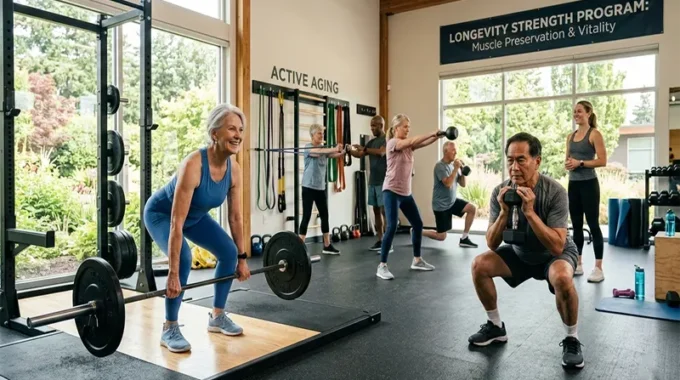
For older adults, the goal of exercise is to maintain a high quality of life—retaining the ability to carry groceries, climb stairs, and play with grandchildren. This is achieved through a structured longevity strength training program designed to optimize “healthspan” (the years spent in good health), not just “lifespan.”
The Biological Case for Resistance
To understand why lifting weights is critical, we must define the two primary villains of aging: sarcopenia and dynapenia.
- Sarcopenia is the involuntary, age-related loss of skeletal muscle mass. Starting as early as age 30, we begin to lose 3% to 8% of our muscle mass per decade, a rate that accelerates after age 60. This loss isn’t just about losing the shape of a bicep; it is a metabolic disaster. Muscle is our body’s primary metabolic sink; it is essential for blood glucose regulation, insulin sensitivity, and maintaining a healthy metabolic rate.
- Dynapenia is the loss of muscle strength that often accompanies, or even precedes, sarcopenia. Crucially, the loss of strength occurs 2 to 5 times faster than the loss of muscle mass. While muscle mass is important, muscle strength (the force that mass can generate) is an even stronger predictor of longevity and physical functional capacity. A classic study, the Health, Aging, and Body Composition Study, followed over 3,000 older adults for nearly a decade and found that knee extensor strength (quadriceps) was significantly and independently associated with mortality risk.
Resistance training directly combats both of these processes. It triggers muscle protein synthesis (building muscle) and strengthens the neural pathways that recruit those muscles (building strength).
The Pillars of a Longevity Strength Training Program
A successful strength program for an aging individual must balance the need for high intensity (to stimulate adaptation) with the absolute requirement for safety and recovery. We recommend four foundational pillars:
1. Compound Movements First
The core of any program should be multi-joint, compound exercises. These move multiple joints and recruit multiple muscle groups, mimicking real-world activities.
- Squats (The ultimate “anti-aging” move): Essential for maintaining the strength to stand up from a chair or toilet. This can range from bodyweight sit-to-stands to goblet squats or barbell back squats.
- Hinges: Exercises like deadlifts or glute bridges teach proper lifting mechanics and strengthen the posterior chain (hamstrings, glutes, lower back), critical for preventing lower back pain.
- Pushes: Overhead presses and push-ups (or chest presses) maintain upper-body strength for pushing doors or placing objects on high shelves.
- Pulls: Rows and pulldowns strengthen the back, essential for maintaining upright posture and “pulling” movements (like starting a lawnmower).
2. Power and Velocity Training
Often overlooked, power training (moving a resistance quickly) is vital. Falls often occur when an individual cannot generate enough force fast enough to correct their balance (known as rate of force development).
Training power might include medicine ball slams, fast concentric (the lifting phase) repetitions with lower weight, or kettlebell swings (for advanced trainees). The mantra is: Keep the movement controlled, but perform the “up” phase with as much speed as can safely be managed.
3. Stability, Balance, and Core
A sturdy trunk protects the spine. Longevity programs must include direct core work that resists movement (like planks, bird-dogs, or Pallof presses). Balance work (single-leg stands) should be integrated, particularly on “off” training days.
4. The Law of Progressive Overload (and Autoregulation)
Muscle will only adapt if it is stressed beyond its current capacity. Progressive overload—gradually increasing the weight, reps, or intensity—is mandatory. However, for active aging, this must be paired with autoregulation. Autoregulation means adjusting the workout intensity based on how you feel that day. If joints feel tender or energy is low, the weights should be reduced. The goal is long-term adherence, not a single heavy workout.
A Sample Weekly Framework
A typical longevity program might involve two to three days of full-body resistance training, with at least one day of rest between sessions. Consistency is more important than extreme effort.
Example 3-Day Split (Full Body focus)
- Monday (Foundation Day):
- Warm-up: 5–10 minutes of dynamic stretching and mobility.
- Power: Medicine Ball Overhead Slams: 3 sets of 6 reps (focus on speed).
- Lower-Body Strength: Goblet Squats: 3 sets of 8–10 reps.
- Upper-Body Push: Push-ups (counter or knee modifications): 3 sets to (safe) failure.
- Upper-Body Pull: Seated Row: 3 sets of 10–12 reps.
- Core: Plank: 3 sets of 30–60 seconds.
- Tuesday: Rest or Active Recovery (e.g., walking, yoga, balance practice).
- Wednesday (Hinge and Posture Day):
- Lower-Body Hinge: Romanian Deadlifts (with dumbbells): 3 sets of 8–10 reps (focus on glute squeeze).
- Upper-Body Push: Overhead Dumbbell Press: 3 sets of 10 reps.
- Core/Stability: Bird-Dog: 3 sets of 12 reps (6 per side, controlled).
- Accessory: Farmer’s Carry (grip strength is a longevity biomarker): 3 sets of 30 seconds.
- Thursday: Rest or Active Recovery.
- Friday (Strength and Accessory Day):
- Single-Leg Strength: Step-ups: 3 sets of 8 reps per leg.
- Upper-Body Pull: Lat Pulldowns: 3 sets of 10–12 reps.
- Upper-Body Accessory: Dumbbell Bicep Curls: 2 sets of 12 reps.
- Finisher: 5 minutes of moderate-intensity stationary cycling.
- Weekend: Full rest or easy walking.
Recovery: The Role of Nutrition
Aging muscle suffers from “anabolic resistance,” meaning it requires a larger protein and training stimulus than young muscle to trigger synthesis. A robust strength program is only half the battle; proper nutrition is required to build the muscle you have “signaled.”
- Increase Protein: Older adults generally require more protein to stimulate muscle growth. The target should be $1.6g$ to $2.2g$ of protein per kilogram of body weight per day, spread across 3–4 meals. For a $70kg$ (154 lb) individual, this is approximately $112g$ to $154g$ of protein daily.
- Timing Matters: Consuming $20g$ to $40g$ of high-quality protein (like whey, lean meat, or eggs) immediately post-workout can help maximize the synthetic response.
The Longevity Mindset
The primary objective of a longevity strength program is to still be training ten, twenty, or thirty years from now. This requires a profound shift in mindset:
- Joint Integrity First: If an exercise hurts (sharp pain, not just muscle burn), stop. Find a variation that does not. Joint health is the gatekeeper of consistency.
- Technique is Non-Negotiable: Ego has no place in a longevity gym. Maintain strict form, and only increase weight when that form is flawless.
- Rethink “Failure”: Training “to failure” (until a rep cannot be completed) is rarely necessary and increases risk for older adults. Focus instead on “Technical Failure”—stopping the set when your form begins to break down. You should often finish a set feeling like you “left one or two reps in the tank.”
Strength training is the ultimate defense against the physical erosion of time. By adopting a smart, structured program that emphasizes safety, power, and compound movements, active aging isn’t just a goal; it’s a reality.