

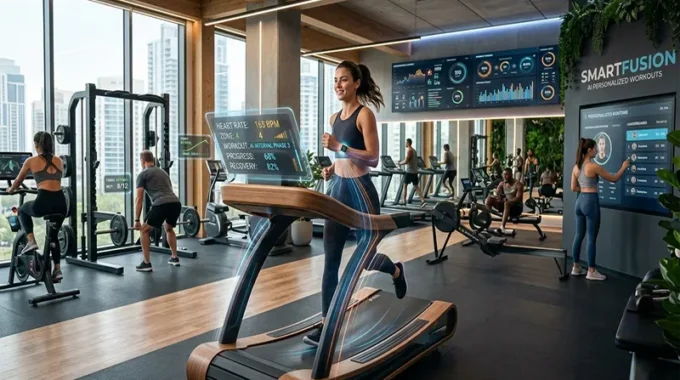
The fitness industry is currently undergoing its most significant transformation since the invention of the barbell. For decades, the gym experience was defined by “one-size-fits-all” circuit training or the hit-or-miss nature of human-led personal training. Today, we are witnessing the rise of the Smart Gym—a high-tech ecosystem where artificial intelligence (AI) and wearable data converge to create a fitness experience that is as unique as a fingerprint.
In this new era, the gym is no longer just a collection of cold iron and treadmills; it is a responsive, data-driven partner in a member’s health journey. By leveraging AI and seamless wearable syncing, these facilities are solving the two greatest hurdles in fitness: lack of personalization and the “guessing game” of recovery.
AI: The Personal Trainer in the Machine
The “Smart” in a modern gym refers to an underlying AI engine that acts as a digital head coach. Unlike traditional PDF workout templates, AI-driven programming is dynamic. It doesn’t just give you a chest workout because it’s Monday; it generates a specific session based on a massive array of data points.
How the AI Personalizes Your Path:
- Biometric Analysis: The AI evaluates your age, weight, body composition, and specific goals (e.g., hypertrophy vs. longevity) to set the baseline.
- The Readiness Score: This is the “secret sauce” of smart gyms. By analyzing your sleep quality, resting heart rate, and heart rate variability (HRV) from the previous night, the AI calculates a “Readiness Score.” If your recovery is low, the AI will automatically pivot your scheduled heavy squats to a restorative mobility session to prevent injury.
- Real-Time Velocity Tracking: Many smart machines now use sensors to track the speed of your repetitions. If the AI detects the bar speed slowing down significantly, it may reduce the weight for the next set or suggest ending the exercise to avoid overtraining.
The Seamless Sync: Wearables as the Data Engine
A smart gym is only as good as the data it receives. This is where wearable data syncing becomes the essential engine. In a connected facility, your Apple Watch, Whoop, Oura Ring, or Garmin doesn’t just track your steps; it communicates directly with the gym’s central nervous system.
When a member walks through the door, their wearable “handshakes” with the gym’s network. The AI instantly looks at the member’s activity outside the gym. Did they go for a 5-mile hike yesterday? The AI will adjust today’s leg volume. Did they only get 4 hours of REM sleep? The gym’s lighting might even shift to a warmer hue at their station, and the workout intensity will be dialed back by 15% to accommodate the neurological fatigue.
This integration eliminates the “silo” effect where what happens in the gym is disconnected from the other 23 hours of the day.
Inside the Smart Gym: A Member’s Journey
To understand the impact of this technology, we must look at the user experience from the moment they step onto the floor.
1. Digital Onboarding
Upon joining, a member completes a digital “movement screen.” Using 3D camera technology or wearable sensors, the AI identifies muscle imbalances or mobility restrictions. This data is used to “gate” certain exercises—for instance, the AI won’t program an overhead press if it detects limited shoulder mobility, instead providing corrective drills to earn that movement.
2. The Interactive Workout
As the member moves to a piece of smart equipment, the machine recognizes them via their wearable.
- Automatic Adjustments: The seat height, handle position, and resistance levels adjust automatically based on the member’s previous performance and current goals.
- AR and Form Feedback: Using Augmented Reality (AR) or integrated screens, the machine provides a “ghost” image of perfect form. If the member’s back rounds during a row, the AI provides an immediate haptic or visual cue to correct the posture.
3. Post-Workout Visualization
The moment the last rep is finished, the data is processed. Members don’t need to manually log sets and reps. They receive a notification on their phone showing their volume, “Time Under Tension,” and a projection of their progress. The AI then suggests a specific recovery protocol—perhaps 10 minutes in the infrared sauna or a specific protein target for the evening.
Benefits for Members and Gym Owners
This technological leap offers a rare “win-win” for both the consumer and the business.
For Members:
- Efficiency: No more wandering around wondering what to do. Every minute in the gym is optimized for results.
- Reduced Injury Risk: By respecting recovery scores and providing form feedback, smart gyms significantly lower the chance of “weekend warrior” injuries.
- Gamification: Seeing real-time “Power Output” or “Level Ups” keeps motivation high during the difficult middle weeks of a program.
For Gym Owners:
- Higher Retention: Members are less likely to cancel when they have a clear, data-backed map of their progress.
- Operational Insights: Owners can see which machines are being used most effectively and which are “bottlenecks” in the flow of the gym, allowing for better floor-plan management.
- Scalable Expertise: AI allows a single coach to oversee 50 members with the same level of personalized data that used to require 1-on-1 attention.
Addressing the Human Element
Despite the heavy reliance on silicon and sensors, the human element remains vital. The role of the “Personal Trainer” in a smart gym evolves into that of a Data Interpreter or Health Architect. While the AI handles the math and the tracking, the human coach provides the empathy, the psychological motivation, and the nuanced understanding of a member’s life that a sensor cannot yet capture.
Data privacy remains a hurdle. Smart gyms must be fortresses of data security, ensuring that sensitive health metrics are encrypted and used solely for the member’s benefit.
The Connected Ecosystem
The gym of the future is not a destination; it is a node in a broader health ecosystem. It is a place where the friction of “what should I do today?” is removed, replaced by a seamless, AI-guided experience that respects your biology. As wearables become more sophisticated and AI becomes more intuitive, the smart gym will move from being a high-end luxury to the standard for anyone serious about optimizing their physical and neurological health.